Introduction to Node.js Architecture
Node.js, developed by Ryan Dahl in 2009, stands out as a runtime environment that allows developers to execute JavaScript code server-side. Its architectural design is a significant departure from traditional server-side technologies, primarily due to its event-driven, non-blocking I/O model. This article provides a deep dive into the key architectural components that make Node.js a high-performance and scalable platform, including the Event Loop, the V8 Engine, and the Module system.
The Event Loop
The Event Loop is the heart of Node.js's asynchronous, non-blocking behavior. Unlike traditional multi-threaded servers, Node.js uses a single-threaded event loop to handle multiple concurrent connections. This eliminates the overhead associated with thread creation and context switching, leading to improved performance and scalability. The event loop continuously monitors the call stack and the event queue. When the call stack is empty, the event loop picks up the next event from the event queue and pushes it onto the call stack for execution.
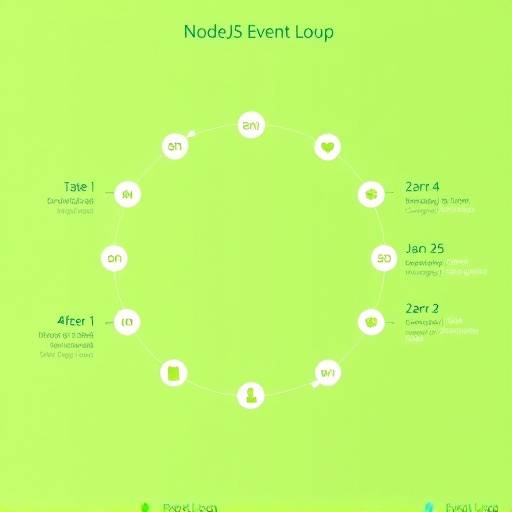
The diagram above illustrates the flow of the event loop. Here's a breakdown of how it works:
- Incoming Requests: Client requests arrive at the Node.js server.
- Event Demultiplexer: The event demultiplexer is responsible for monitoring file system events, network requests, and other external events. It efficiently manages these events using the operating system's asynchronous I/O mechanisms.
- Event Queue: Once an event is detected, it is placed into the event queue. This queue is a FIFO (First-In-First-Out) data structure.
- Event Loop: The event loop continuously checks the call stack. If the call stack is empty, it pulls the first event from the event queue and pushes the associated callback function onto the call stack.
- Call Stack: The callback function is executed in the call stack. Any synchronous code within the callback is executed immediately. Asynchronous operations are delegated back to the event demultiplexer.
- Callbacks: Once asynchronous operations complete, their callbacks are placed in the event queue, waiting for the event loop to pick them up.
This design allows Node.js to handle a large number of concurrent connections without blocking, making it ideal for real-time applications, such as chat applications and online gaming servers.
The V8 Engine
Node.js leverages the V8 JavaScript engine , developed by Google, to execute JavaScript code. V8 is renowned for its high performance, achieved through techniques such as just-in-time (JIT) compilation and optimized memory management. By embedding V8, Node.js benefits from the engine's ability to rapidly execute JavaScript, which is critical for server-side operations.
The V8 engine performs the following key tasks:
- Parsing: V8 parses JavaScript code into an Abstract Syntax Tree (AST).
- Compilation: The AST is then compiled into machine code. V8 uses a combination of full-code compilation and JIT compilation to optimize performance.
- Optimization: The engine continuously profiles and optimizes the compiled code at runtime, identifying and re-compiling hot spots to improve execution speed.
- Garbage Collection: V8's garbage collector automatically reclaims memory that is no longer in use, preventing memory leaks and ensuring efficient memory utilization.
The integration of V8 enables Node.js to execute JavaScript at near-native speeds, making it a competitive choice for performance-sensitive applications.
Node.js Modules
Node.js provides a modular architecture that allows developers to organize and reuse code effectively. Modules in Node.js are self-contained units of functionality that can be imported and used in other parts of an application. The Node.js module system is based on the CommonJS specification, which defines a simple way to define and import modules.
Key features of the Node.js module system include:
- Encapsulation: Modules encapsulate code, preventing naming conflicts and promoting code reuse.
- Dependencies: Modules can declare dependencies on other modules, allowing developers to build complex applications by composing smaller, manageable units.
- Package Management: The Node Package Manager (npm) is a powerful tool for managing module dependencies. npm allows developers to easily install, update, and uninstall modules from the npm registry, a vast repository of open-source packages.
Node.js also includes a set of built-in modules, such as
http
,
fs
, and
path
, which provide essential functionality for building server-side applications. For example, the
http
module allows developers to create HTTP servers and clients, while the
fs
module provides access to the file system.
| Module | Description |
|---|---|
http
|
Provides functionality for creating HTTP servers and clients. |
fs
|
Provides access to the file system, allowing you to read, write, and manipulate files. |
path
|
Provides utilities for working with file and directory paths. |
url
|
Provides utilities for parsing and formatting URLs. |
net
|
Provides an asynchronous network API for creating TCP servers and clients. |
crypto
|
Provides cryptographic functionality, such as hashing, encryption, and decryption. |
Core Components and Libraries
Node.js architecture also relies on several core components and libraries that enhance its capabilities. These include:
- libuv: A multi-platform support library with a focus on asynchronous I/O. It provides the event loop, thread pool, and handles all asynchronous system calls.
- Streams: Node.js streams provide a powerful way to handle streaming data, allowing you to process large amounts of data efficiently.
- Buffers: Buffers are used to represent binary data in Node.js. They provide a way to manipulate raw data, such as images, audio, and video.
Conclusion
Node.js's architecture, characterized by its event loop, V8 engine, and modular design, enables it to deliver high performance and scalability for server-side JavaScript applications. Understanding these core components is crucial for developers seeking to leverage the full potential of Node.js. By embracing its asynchronous, non-blocking nature, developers can build responsive and efficient applications that meet the demands of modern web environments. With its thriving ecosystem and extensive module library, Node.js continues to be a leading choice for building a wide range of applications, from web servers to real-time systems.
If you have any further questions or need assistance, please contact us at NovaTech Solutions.